Key takeaways
- Market intelligence and validation
- Sourcing and logistics
- Conversion-ready listing
Table of contents
Amazon seller roadmap: building toward consistent revenue
Amazon can support several income models, but outcomes depend on capital, category, execution, and policy risk. "zero to $10,000" in the URL is a milestone framing only; it is not a promise of monthly income or a timeline. Related notes: product research: find profitable products; inventory: FBA inventory forecasting; PPC: Amazon PPC framework.
Related: full account management, Amazon PPC, and Seller Central.
Business-model choices
- Private label - brand ownership and margin potential; higher upfront risk
- Wholesale - branded distribution; compliance and MAP constraints
- Retail/online arbitrage - learning vehicle; often weak for durable scale
- KDP / Merch - low inventory; skill- and content-dependent
- Affiliate / influencer - commission income; audience-dependent
Pick one primary model before mixing complexity.
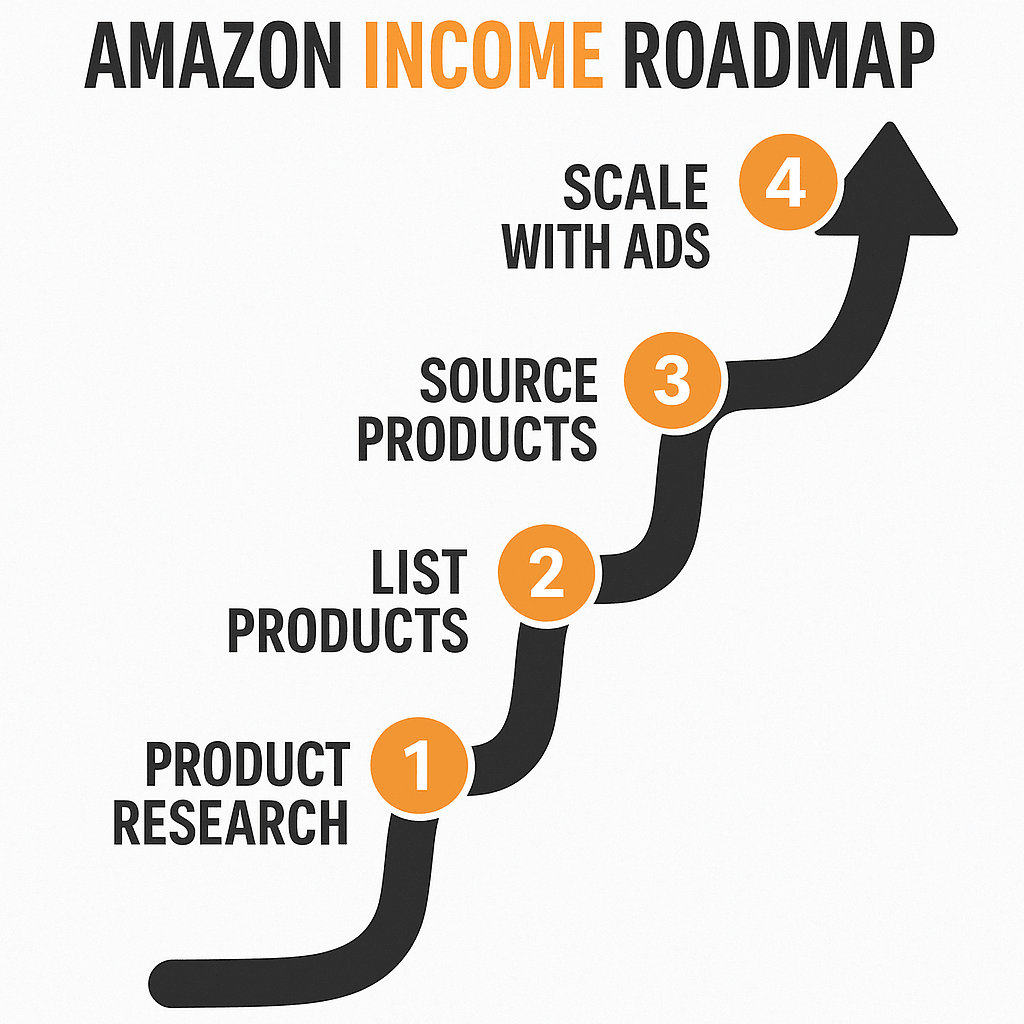
Stage map (milestone, not guarantee)
1) Market intelligence and validation
Checks: demand stability, differentiation room, price/fee economics, supplier reliability, legal/IP risk. Skip "low competition" fantasies without demand evidence.
2) Sourcing and logistics
Verify capacity, QC, samples, and lead times. Logistics: freight mode, duties, reorder points, and stockout/overstock tradeoffs.
3) Conversion-ready listing
Keyword architecture, clear images, benefit-led copy, A+ when eligible. Listing quality compounds paid traffic efficiency.
4) Launch and early velocity
Mix: Sponsored ads + ethical review requests via Amazon programs + competitive launch pricing. Practice: follow Amazon's review solicitation rules.
5) Advertising with profit guards
Layer auto → research → exact; track ACoS, TACoS, CVR, and contribution after fees. Ads without unit economics tracking can scale losses.
6) Scale levers (when economics work)
Bundles, packaging upgrades, premium variants, Brand Store cross-sell, disciplined cash forecasting, backup suppliers. Monthly revenue milestones (including five-figure targets) are not verified for any reader account.
Risk register
Price wars, supply disruption, listing health issues, and policy changes. Practice: safety stock, dual sourcing for core SKUs, and weekly listing-health checks.
Bottom line
Treat Amazon growth as a staged operating system: model → validate → list → launch → ads → scale with margins. That structure improves odds versus improvisation; it does not guarantee $10,000 per month.
Request a free Amazon audit to review your stage and unit economics, or contact eCom Gliders for Amazon growth support.
About the author
Mary
Content Specialist
Mary writes practical Amazon seller guides covering PPC, SEO, listing optimization, and account management.
Keep reading
Related articles
- Business StrategyHow to Build a Scalable Amazon Business Strategically: A Practical Sequence6 min read
- Business StrategyHow to Build an Amazon Business That Scales Strategically: What Scale Means6 min read
- Business StrategyAmazon as a System: How Strategic Architecture Supports Market Leadership6 min read


